

The Tai language family
Languages in bold below are major languages, in terms of numbers of speakers, or by having national status. Those marked with an asterisk have their own distinctive writing system (which in some cases is used by others in the language family).
|
Subdivisions of the Tai language family:
|
Spread of the Tai language family: 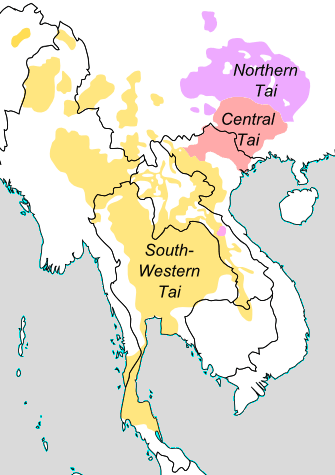 Adapted from Wikipedia’s Kradai map. |
Writing systems of the Tai family
In all cases, the languages which use neither Roman alphabet nor Chinese logograms use writing systems deriving from the Brahmi family of scripts. The parent in most cases is Pallava (a South Indian script), though there may have been various influences from North Indian (Ashokan) or Central Asian (Aramaic) scripts. Information about those with an asterisk can be found on Omniglot.
Ahom* Dehong Dai Shan Khün (variation of Lanna) Tai Lue Tai Dam* Tai Song (variation of Tai Dam) Lao* Lanna Isan (variation of Lanna) Thai* Thai (Sukhothai period) Khom Thai
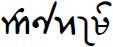


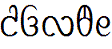


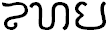

>>> See also my handy input method for Thai,
for when you don’t have a Thai keyboard.
Preservation of Pali texts
With the spread of Buddhism to Southeast Asia from South India, came
scriptures in the Pali language. Strictly speaking, Pali had no written
form of its own, and was preserved in the local script wherever one was
available. In SE Asia, a large number of Pali texts were preserved in
Lanna, Lao, Thai and other southern Tai scripts. In most cases, special
letters or spelling methods were needed for the correct representation
of Pali (see Thai and Lao for Pali). In
Thailand, an experimental script specifically for Pali was designed in
1833 by King Rama IV, the charming Ariyaka script.