
Since the invention of writing 5,000 years ago, there have been many outstanding achievements in both the conceptual and aesthetic forms of the writing systems used. Many examples can be found at Simon Ager’s website Omniglot of writing systems which had an inherent ability to satisfy the needs of writers and their readers for very long periods of time. Omniglot also has many examples of writing systems invented in the last few years by hobbyists. Both of these groups were of special interest to me as I developed SIGIL for the book Language for the World. Here are some of my favourite recently-invented scripts.

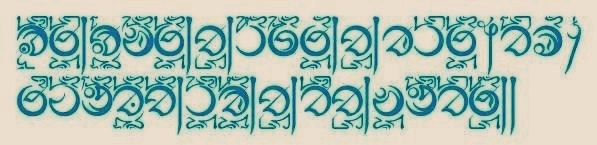
Qohenje was invented by Colin Harrison. It is especially interesting because of the way it makes vowels the main element, adding consonants as diacritics. After all, consonants can be heard as mere stopping points within a flow of musically clear sounds (which are the vowels). This extended example is adapted from Colin Harrison’s website:
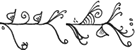
The Ayeri Ornament Script is by Carsten Becker. A lovely idea, taking inspiration from natural linear forms, in this case vines. It is a simple cypher, but because of its decorative nature does not look dull.
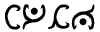
The Nari alphabet is by Thomas Slawson. When written out in lines it forms a nice organic pattern. Again, a simple cypher without being dull.

The qosta writing system was created by Adam Heurlin. It reminds me of some Tai scripts, and indeed looks as convincing and complete as any natural language script, while still being logically efficient.

The Tciaar alphabet is by Ricardo Reséndiz Maita and Cialy Saturno Maita. An attractive development of Arabic-style scripts, in this case written L-to-R and designed for European languages. The letters sit well together, and there are no unwritten phonemes.

Tsolyáni is one of the scripts by Muhammad Barker featured in his fantasy world Tékumel. It runs cursively R-to-L like a crazy Arabic.
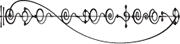
Golic Vulcan traditional calligraphy was developed by Britton Watkins, based on designs of Star Trek artistic director Michael Okuda. It is a very sophisticated and unique system, though extremely awkward as a human orthography.
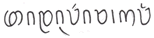
The Tadváradcel script was invented by Sarah Maiocchi, for her Language of the Wind. It is a nice example of its type, and its description is reminiscent of my own Xylphika.
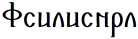
The Gyorsrovás script is a revision of the Hungarian runic system by Attila Répai, and he has given it a beautifully printable font.