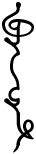
Fontok is a kind of shorthand inspired by the calligraphic style of China and Japan called wild cursive (k’uang tsao). Mongolian was also an influence. It is in essence a structured scribbling, with phonemes assigned to particular movements of the pen. The name comes from the Thai word for “falling rain”, and also has connotations with “font” and “phonetics”.
Notable Features
- a cursive phonemic alphabet.
- written in vertical columns top to bottom – this allows a very comfortable flow of the pen.
- columns flow left to right – this avoids smudging, and allows us to see what has gone before.
- written without diacritics, so each word is formed with a single continuous stroke.
- modeled on random word-like scribblings (automatic writing).
- designed for use with English.
|
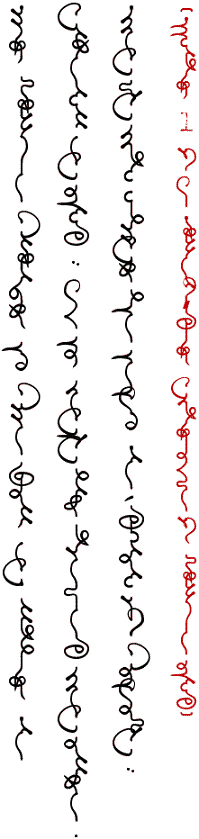
Example[down the left] “All human beings are born free and equal in ConsonantsThe consonantal phonemes of English were ranked by frequency, and the most common were assigned to the easiest, most natural shapes. Rarer phonemes like /th/ of thing and the /zh/ in measure were assigned to more complicated, less naturally-flowing shapes. A relatively small set of curves and knots was chosen, and then mirrored to bring the total number up to match the number of consonantal phonemes in English. It turns out that for English, the dental phonemes are generally more common than the bilabials and velars. For this reason, the more natural side of the central axis for forming curves (left side for right-handed writers, right side for left-handed writers) has mainly those phonemes. The mirrored shapes were then given roughly equivalent articulations to those of the main (outer) side. VowelsThe vowels of English can be grouped roughly into 6 pairs of short and long, where each pair is seen to share similar articulation. A long vowel is simply represented as duplication of a short vowel.
|
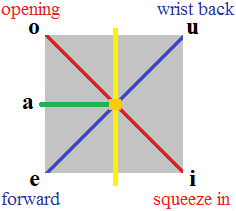
Chart
In the following chart of Fontok shapes, the yellow line shows the central axis of writing. For shapes like /s/, /d/ and /v/, a slight extension from the end-point, or to the start-point, may be drawn.
When the end of a word is reached, a slight tail may be added for aesthetics; the direction—left or right—is chosen to balance the overall lateral weight of the written word. This is especially useful in the strictly vertical printed font.
The diphthongs are given with simplified phonetics, to show clearly how the shapes are derived from two single vowel marks. The solo mark labeled /a/ is an abbreviated form used for the indefinite article of English. A small ring may be prefixed to a word as a capitalizer (see my name in the tattoo page, for example).
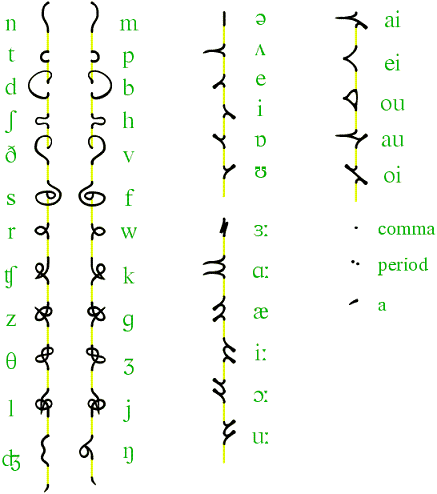
NB. This chart and the vowel diagram were designed for right-handed writers;
left-handers can simply use a mirror image of the system.
A version of this page can also be found on
Omniglot.